
Most people assume that managing money well is a matter of earning more, but the bigger differences usually come from the small, everyday decisions shaped by what you understand about personal finance. A misunderstanding about how interest works, a skipped savings habit, or a vague idea of where your money goes can quietly compound over years into a serious financial setback. These are common financial knowledge mistakes, and the good news is that almost all of them are preventable once you recognize them.
It is important to be clear about one thing: these errors rarely stem from a lack of intelligence. They usually come from outdated assumptions, skipped fundamentals, and the sheer volume of conflicting financial information online. Many people were simply never taught the basics in a structured way, so they fill the gaps with guesswork and habits picked up from friends, family, or social media.
This guide breaks down the most frequent money-management misconceptions and pairs each one with a simple, actionable correction. Where helpful, it points to authoritative U.S. financial-education resources such as the Consumer Financial Protection Bureau (CFPB), Investor.gov from the Securities and Exchange Commission, the FDIC, and MyMoney.gov, so you can verify the fundamentals yourself rather than relying on hearsay. None of this is personalized financial advice, but understanding these patterns is one of the most reliable ways to protect your money.
Why Financial Knowledge Gaps Are So Common
Before fixing individual mistakes, it helps to understand why they happen so often. Financial knowledge gaps are widespread for reasons that have very little to do with personal failure and a lot to do with how money topics are taught and communicated.
Limited Formal Financial Education
Many people complete their entire formal education without ever taking a structured course on budgeting, credit, or investing. As a result, the first time they encounter concepts like compound interest or credit utilization is often when they are already making a real-world decision with real consequences. Government literacy hubs such as MyMoney.gov exist precisely because this gap is so common, offering plain-language explanations of saving, spending, borrowing, and protecting money.
Emotional and Reactive Decisions
Money is emotional. Fear, excitement, and social pressure can override careful reasoning. People may panic-sell investments during a downturn, overspend to match peers, or avoid checking accounts because the numbers cause anxiety. These emotional reactions frequently lead to decisions that look obviously wrong in hindsight but felt urgent in the moment.
Information Overload
Ironically, the abundance of financial content can make things worse. Social media is full of confident voices offering contradictory tips, and it is difficult for a beginner to separate solid fundamentals from hype or outright misinformation. The antidote is to anchor your understanding in stable, authoritative sources and treat everything else as opinion until verified.
Mistake 1: Budgeting Without Tracking Where Money Actually Goes
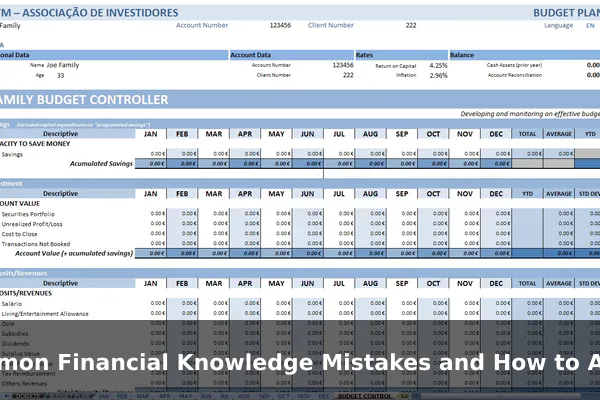
One of the most common financial knowledge mistakes is confusing the act of making a budget with the discipline of following and monitoring one. Plenty of people create a tidy spreadsheet at the start of the month, then never compare it to what actually happened. A budget that is never reviewed is closer to a wish list than a financial tool.
The CFPB and other consumer-finance educators consistently emphasize that tracking spending is what makes a budget useful. Without tracking, you cannot see the small recurring leaks, forgotten subscriptions, impulse purchases, and fees that quietly add up.
How to Build a Budget You Will Actually Use
- Start with real numbers, not ideals. Pull a month or two of actual transactions before setting targets so your categories reflect reality.
- Separate fixed and variable spending. Fixed costs (rent, insurance) are predictable; variable costs (food, entertainment) are where most overspending hides.
- Review weekly, not just monthly. A short weekly check-in catches problems early instead of at the end of the month when it is too late to adjust.
- Give every dollar a job. Assign income to spending, saving, and debt categories so leftover money does not silently disappear.
The goal is not perfection. It is awareness. When you can clearly see where your money goes, almost every other financial decision becomes easier.
Mistake 2: Skipping an Emergency Fund
Another widespread error is treating savings as whatever happens to be left over rather than as a planned priority. Without a dedicated cash buffer, an unexpected car repair, medical bill, or income gap can force you into high-interest debt, which then compounds the original problem.
Financial-education programs like FDIC Money Smart and MyMoney.gov repeatedly highlight the value of an accessible emergency fund. While you will often hear general rules of thumb about saving several months of expenses, the right amount depends on your individual situation, so treat any specific figure as a starting reference rather than a fixed requirement.
How to Start an Emergency Fund From Zero
- Begin small and automatic. Even a modest, automatic transfer each payday builds momentum and removes the temptation to skip it.
- Keep it separate and accessible. A distinct savings account reduces the urge to spend the money and keeps it available when you genuinely need it.
- Define what counts as an emergency. Reserving the fund for true surprises, not planned purchases, protects its purpose.
- Rebuild after you use it. Treat replenishing the fund as a priority once the emergency passes.
An emergency fund is less about the exact balance and more about breaking the cycle where every surprise becomes a debt. Even a partial buffer dramatically reduces financial stress.
Mistake 3: Mismanaging Credit and Debt
Few areas generate as many misconceptions as credit and debt. Misunderstanding how credit scores work, paying only the minimum on balances, or underestimating the true cost of high-interest debt are all common financial knowledge mistakes that can follow people for years.
Misunderstanding Credit Scores
Many people believe credit scores are mysterious or that checking their own score will hurt it. In reality, consumer-protection resources from the CFPB explain that reviewing your own credit reports is a healthy habit and does not lower your score. Credit scores generally reflect factors like payment history, how much of your available credit you use, and the length of your credit history. Understanding these drivers lets you improve your standing intentionally rather than by guesswork.
The Trap of Minimum Payments
Paying only the minimum on a credit card may feel responsible because you are “keeping up,” but high interest means the balance can shrink very slowly while costing a great deal over time. Whenever possible, paying more than the minimum, and prioritizing the highest-interest balances, reduces the total cost of debt significantly.
Responsible Credit Habits
- Pay on time, every time. Payment history is one of the most influential factors in credit scoring.
- Keep balances low relative to limits. Lower credit utilization is generally viewed more favorably.
- Avoid opening too many accounts at once. Frequent applications can signal risk.
- Read the terms before borrowing. Interest rates, fees, and repayment schedules matter more than the advertised offer.
Because lending rules, rates, and product terms change over time, it is wise to confirm current details with the lender or an official source such as the CFPB before making credit decisions.
Mistake 4: Misunderstanding Investing Basics
Investing is where small misunderstandings can have outsized long-term effects. Common errors include ignoring fees, underestimating the power of compounding, chasing recent high returns, and failing to diversify. Investor.gov, the SEC’s educational resource, addresses each of these directly and is a reliable place to verify the fundamentals.
Ignoring Fees and Underestimating Compounding
Fees may look trivial as a percentage, but over decades they can consume a meaningful portion of your returns. Compounding works the same way in reverse: just as gains build on gains over time, recurring costs quietly erode the base that those gains grow from. Understanding both forces helps explain why low costs and long time horizons matter so much.
Chasing Returns and Skipping Diversification
Buying whatever performed best recently is one of the most common investing mistakes. Past performance does not guarantee future results, and concentrating money in a single hot asset increases risk. Diversification, spreading money across different types of investments, is a widely taught principle for managing that risk.
- Understand what you own. Avoid investments you cannot explain in simple terms.
- Mind the costs. Compare fees and expenses, since they directly reduce returns.
- Think in years, not days. Long time horizons let compounding work in your favor.
- Avoid reacting to hype. A consistent, boring strategy often outperforms frequent guessing.
This is general education, not investment advice. Your own goals, timeline, and risk tolerance should guide any real decisions, and official resources like Investor.gov can help you research before you act.
Mistake 5: Falling for Financial Scams and Fraud
Even financially literate people can be targeted by increasingly sophisticated scams. Recognizing red flags is a core piece of financial knowledge that protects everything else you have built. Both Investor.gov and the CFPB publish fraud-protection resources to help consumers verify legitimate institutions and offers.
Common Red Flags
- Guaranteed high returns with no risk. Legitimate investments always carry some risk; promises of guaranteed gains are a classic warning sign.
- Pressure to act immediately. Urgency is a manipulation tactic designed to bypass careful thinking.
- Requests for unusual payment methods. Demands for gift cards, wire transfers, or crypto to a stranger are major warning signs.
- Unsolicited contact. Be skeptical of unexpected calls, emails, or messages claiming to be from your bank or a government agency.
How to Verify Before You Trust
When in doubt, slow down and verify independently. Look up institutions through official channels rather than links provided in a message, confirm that investment professionals and firms are properly registered, and never share login credentials or one-time codes. Taking a few minutes to verify is far cheaper than recovering from fraud.
Mistake 6: Ignoring Long-Term and Retirement Planning
Because retirement can feel distant, many people delay long-term planning, not realizing that time is the single most powerful tool they have. Starting early, even with modest contributions, allows compounding to do much of the heavy lifting. Delaying that start can mean having to save far more aggressively later to reach the same place.
The Cost of Waiting
The earlier money is set aside for long-term goals, the longer it has to potentially grow. Someone who begins modestly in their twenties may end up better positioned than someone who starts much larger contributions decades later, simply because of the extra years of compounding. This is why financial educators emphasize starting, even small, as soon as possible.
Practical Long-Term Habits
- Treat long-term saving as a recurring bill. Automating contributions removes reliance on willpower.
- Increase contributions gradually. Raising the amount slightly when your income grows compounds your progress.
- Revisit your plan periodically. Life changes, and your goals and savings rate should be reviewed over time.
- Use official resources to learn the basics. Rules around retirement accounts can change, so confirm current details before acting.
As with investing, keep the framing general and verify specifics, since contribution limits, tax rules, and account types are subject to change.
How to Build Stronger Financial Habits That Last
The most reliable way to avoid these common financial knowledge mistakes is not a single dramatic change but a repeatable routine that keeps you informed and consistent. When you turn good decisions into habits, you no longer have to rely on motivation in the moment.
A Simple Repeatable Routine
- Review. Check your spending, savings, and balances on a regular schedule so problems surface early.
- Automate. Set up automatic transfers for savings, debt payments, and long-term contributions so progress happens by default.
- Educate. Spend a little time regularly learning fundamentals from trustworthy sources rather than reacting to social media trends.
- Verify. Before any significant money decision, confirm the details with an official or primary source.
Where to Keep Learning
Make a habit of returning to authoritative, stable resources. The CFPB offers practical guidance on budgeting, credit, and debt; MyMoney.gov serves as a federal hub for financial literacy; the FDIC’s Money Smart program covers banking and saving; Investor.gov explains investing basics and fraud protection; and the Federal Reserve Board publishes consumer financial data and reports. Anchoring your knowledge to sources like these helps you filter out noise and misinformation.
Conclusion
Almost every costly money mistake traces back to a small, fixable gap in understanding rather than a lack of effort or intelligence. Budgeting without tracking, skipping an emergency fund, mismanaging credit, misunderstanding investing, falling for scams, and delaying long-term planning are all common precisely because the fundamentals are rarely taught clearly. Once you can name these patterns, you can guard against them.
The corrections are refreshingly simple: track your spending, save automatically, treat debt seriously, keep investing costs low and diversified, verify before you trust, and start long-term planning early. None of these require a finance degree, only consistency and a willingness to confirm the details with reliable sources. By building a steady routine of reviewing, automating, educating, and verifying, you turn scattered good intentions into durable financial strength, and you protect yourself from the quiet, compounding cost of avoidable mistakes.
Official references
- Consumer Financial Protection Bureau – U.S. regulator providing authoritative guidance on budgeting, debt, credit, and avoiding common money management mistakes.
- MyMoney.gov (U.S. Financial Literacy and Education Commission) – Official U.S. federal hub for financial literacy, covering saving, spending, borrowing, and protecting money.
- Investor.gov (U.S. Securities and Exchange Commission) – SEC resource explaining investing basics, fees, compounding, and avoiding investment mistakes and fraud.
- Federal Deposit Insurance Corporation (FDIC) Money Smart – Government financial education program on banking, saving, and managing credit responsibly.
- Federal Reserve Board – Central bank publishing consumer financial data and reports relevant to household money decisions.
