
A stock exchange is one of the most influential institutions in modern finance, yet most people interact with it without ever stepping onto a trading floor or watching a single price tick. Whenever you contribute to a retirement account, buy shares through a brokerage app, or hold an index fund, you are participating in a system that ultimately runs through a regulated marketplace where the ownership of companies changes hands. Understanding how that marketplace functions can transform the way you think about investing, the economy, and your own financial future.
At its core, a stock exchange exists to connect two groups: companies that need capital to grow, and investors who want to put their money to work. It does this by providing a transparent, rule-bound venue where shares of publicly listed companies can be bought and sold quickly and fairly. According to investor education resources from the U.S. Securities and Exchange Commission (SEC), exchanges are designed to promote orderly trading, price transparency, and investor confidence—qualities that make markets trustworthy enough for millions of people to participate.
In this guide, we will demystify how a stock exchange actually works, from the moment an order is placed to the way prices are formed. We will look at the difference between primary and secondary markets, the key participants who keep trading running smoothly, the role of regulators, and ultimately why stock exchanges matter for both everyday investors and the broader economy. The goal is clarity: by the end, the mechanics behind the headlines should feel far less mysterious.
What Is a Stock Exchange?
A stock exchange is a regulated marketplace where shares (also called stocks or equities) of publicly listed companies are bought and sold. Think of it as a highly organized auction house dedicated to financial securities. Instead of paintings or antiques, the items being traded are fractional ownership stakes in real businesses. When you own a share, you own a small piece of that company, including a claim on its future earnings and assets.
It is important to distinguish a stock exchange from a few related terms that are often used interchangeably:
- The stock market is the broad, umbrella concept that refers to all the trading of stocks across many venues and systems. A stock exchange is a specific, organized venue within that larger market.
- A broker or brokerage is the intermediary that connects an individual investor to the exchange. You typically cannot trade directly on an exchange yourself; instead, you place an order through a broker, who routes it to the appropriate venue.
- A listed company is a business whose shares have met the exchange’s requirements and are available for public trading.
Well-Known Examples of Stock Exchanges
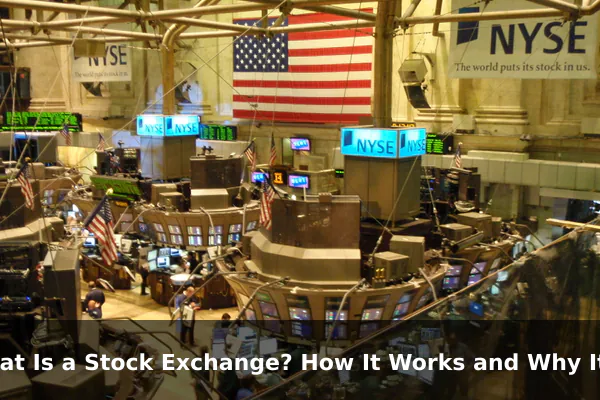
Some exchanges have become household names. The New York Stock Exchange (NYSE) is often cited as the largest stock exchange in the world by the market value of its listed companies, and it is known historically for its physical trading floor. Nasdaq, by contrast, pioneered fully electronic trading and is home to many technology-focused companies. Around the globe, dozens of other major exchanges operate, and the World Federation of Exchanges (WFE) serves as a global industry body that tracks and standardizes information across these venues.
Exchanges Are Regulated Venues
A defining feature of a legitimate stock exchange is regulation. In the United States, exchanges operate under the oversight of the SEC, which sets rules intended to ensure fair dealing, accurate disclosure, and investor protection. This regulatory backbone is what separates a trustworthy public market from an unregulated or speculative trading arrangement. Because rules and regulatory structures can evolve over time, investors are encouraged to consult official sources such as the SEC or Investor.gov for the most current details.
How a Stock Exchange Works
The everyday magic of a stock exchange lies in order matching—the process of pairing someone who wants to buy with someone who wants to sell at a mutually acceptable price. While the underlying technology has grown enormously sophisticated, the basic logic remains intuitive.
Orders, Bids, and Asks
When an investor wants to trade, they submit an order through their broker. There are two fundamental prices involved:
- The bid is the highest price a buyer is currently willing to pay for a share.
- The ask (or offer) is the lowest price a seller is currently willing to accept.
The small gap between these two figures is called the bid-ask spread. A trade occurs when a buyer’s bid and a seller’s ask meet, or when an investor agrees to transact at the best available price on the other side.
The Order Book
Behind the scenes, the exchange maintains an order book: a continuously updated list of all outstanding buy and sell orders, organized by price and quantity. The order book is the heart of price discovery. It reveals where demand and supply sit at any given moment, and it allows the exchange’s matching engine to pair compatible orders automatically and fairly, typically prioritizing the best prices and, often, the earliest orders.
Step by Step: How a Trade Executes
- An investor decides to buy or sell and places an order with their broker, specifying the stock, the quantity, and the type of order (for example, a market order or a limit order).
- The broker routes the order to an exchange or trading venue.
- The exchange’s matching engine searches the order book for a compatible counterparty.
- When a match is found, the trade is executed and a price is set.
- The transaction then moves to clearing and settlement, where ownership and funds are officially transferred—a process handled by specialized clearing entities.
Floor Trading vs. Electronic Trading
For much of history, trading happened on a physical floor, where human traders shouted orders and used hand signals. Today, the vast majority of trading is electronic. Nasdaq, for instance, was built from the ground up as an electronic market, and even traditional venues like the NYSE now execute most volume through computer systems. Electronic trading dramatically increases speed, lowers costs, and allows orders to be matched in fractions of a second, while still operating under exchange rules designed to keep the process orderly.
Primary vs. Secondary Markets: How Shares Get Listed and Traded
A common point of confusion is whether buying a stock sends money directly to the company. Usually, it does not. To understand why, it helps to separate the primary market from the secondary market.
The Primary Market: Where Shares Are Created
The primary market is where a company first sells new shares to investors. The best-known example is an initial public offering (IPO), when a private company “goes public” by listing its shares on an exchange for the first time. In this process, the company raises capital directly, which it can use to expand operations, pay down debt, fund research, or invest in growth. The primary market is therefore the engine of capital formation.
The Secondary Market: Where Shares Are Traded
Once shares exist and are listed, they trade among investors on the secondary market—and this is what most people mean when they talk about “buying stocks.” When you purchase shares of an established company, your money typically goes to another investor who is selling, not to the company itself. The secondary market provides liquidity, meaning investors can convert their holdings back into cash relatively easily, which in turn makes the primary market more attractive to new buyers.
Listing Requirements and Why Companies List
To be listed on a major exchange, a company generally must meet certain standards, which may include minimum financial thresholds, corporate governance practices, and ongoing disclosure obligations. Specific requirements vary by exchange and can change over time, so companies and investors should review official exchange documentation for current criteria. Companies pursue a listing for several reasons:
- Access to a large pool of capital from public investors.
- Enhanced visibility, credibility, and brand recognition.
- Liquidity for early investors and employees who hold shares.
- The ability to use publicly traded stock for acquisitions or compensation.
Key Participants and Their Roles
A stock exchange functions because of a network of participants, each playing a distinct role in keeping trading liquid and orderly.
Listed Companies
These are the businesses whose shares are traded. In exchange for access to public capital, they accept ongoing responsibilities, especially the obligation to disclose material financial information so investors can make informed decisions.
Retail and Institutional Investors
Retail investors are individuals trading for their own accounts, often through brokerage apps or retirement plans. Institutional investors—such as mutual funds, pension funds, and asset managers—trade in much larger volumes and represent a significant share of overall market activity. Both groups supply the demand and supply that drive trading.
Brokers
Brokers act as the gateway between investors and the exchange. They accept orders, route them to trading venues, and handle the administrative side of buying and selling. Many modern brokers offer commission-free trading and easy-to-use platforms, which has broadened public access to markets.
Market Makers and Specialists
Market makers are firms that stand ready to buy and sell particular stocks, quoting both a bid and an ask. By continuously offering to trade, they provide liquidity and help ensure that investors can transact even when a natural counterparty is not immediately available. They typically earn the bid-ask spread as compensation for taking on this role and risk.
Clearing and Settlement Entities
After a trade is agreed, it must be finalized. Clearing confirms the details and obligations of both parties, and settlement is the actual transfer of shares and cash. Specialized institutions handle this behind-the-scenes process, which is essential to ensuring that trades are completed reliably and that counterparty risk is minimized.
How Stock Prices Are Determined
One of the most frequently asked questions about markets is how stock prices are actually set. The short answer is supply and demand, expressed continuously through the order book.
Supply, Demand, and the Spread
If more investors want to buy a stock than sell it, buyers compete by bidding higher, and the price tends to rise. If sellers outnumber buyers, prices tend to fall. The bid-ask spread reflects the immediate tension between these forces. Highly traded stocks usually have narrow spreads and ample liquidity, while thinly traded ones may have wider spreads.
The Role of Information and Sentiment
Prices respond to new information. Company earnings reports, economic data, interest rate expectations, industry developments, and broader investor sentiment can all move prices, sometimes sharply. Because markets aggregate the expectations of countless participants, prices reflect a constantly shifting consensus about a company’s prospects.
It is important to be cautious here: while these dynamics explain why prices move, they do not make movements predictable. Markets are influenced by countless variables, and past behavior does not guarantee future outcomes. No one can reliably forecast short-term price changes, and investing always involves risk, including the potential loss of money. For balanced, non-promotional explanations, resources like Investor.gov offer educational material aimed at helping investors set realistic expectations.
Regulation and Investor Protection
Trust is the foundation of any functioning market, and regulation is what underpins that trust. In the United States, the SEC serves as the primary regulator of securities markets, overseeing exchanges and enforcing rules designed to protect investors and maintain fair, orderly, and efficient markets.
What Regulators Generally Do
- Enforce disclosure: Public companies must regularly share financial information so investors can make informed decisions, reducing the information gap between insiders and the public.
- Police misconduct: Regulators investigate and act against fraud, market manipulation, and insider trading.
- Oversee market structure: Exchanges themselves operate under rules and supervision intended to keep trading transparent and orderly.
- Support investor education: Official resources help everyday investors understand their rights and the risks involved.
Why Oversight Matters
Without credible oversight, investors would have little reason to trust prices or believe that the playing field is reasonably level. Regulation does not eliminate risk—markets can and do fall—but it reduces the chance of fraud and increases transparency. Because specific rules, enforcement priorities, and regulatory frameworks can change over time and differ by country, investors should rely on official regulators for current, authoritative guidance rather than informal summaries.
Why Stock Exchanges Matter
Stock exchanges are far more than venues for speculation. They perform several functions that ripple through the entire economy and into the lives of ordinary people.
Capital Formation for Companies
By enabling companies to raise money from the public, exchanges fuel business growth, innovation, and job creation. Capital raised through public markets can finance new factories, products, and research, contributing to broader economic development.
Wealth Building and Liquidity for Investors
For individuals, exchanges offer a way to participate in the growth of businesses over time. Through diversified vehicles like index funds, many people build long-term savings, often for retirement, by owning small stakes in many companies. The liquidity that exchanges provide means investors can generally buy or sell when they need to, an essential feature for personal financial planning.
Price Discovery and Economic Signaling
Exchanges continuously generate prices that reflect collective expectations about companies and the economy. This price discovery helps allocate capital toward businesses that investors believe will use it productively. Aggregate market movements can also serve as a barometer of economic sentiment, although they are an imperfect and sometimes volatile signal.
A Global Network
Stock exchanges operate across virtually every major economy, and bodies such as the World Federation of Exchanges help standardize information and statistics worldwide. This global network links savers and businesses across borders, integrating economies and broadening the opportunities available to investors and companies alike.
Frequently Asked Questions
What is the difference between a stock exchange and the stock market?
The stock market is the broad concept encompassing all stock trading, while a stock exchange is a specific, regulated venue within that market where shares are bought and sold. In short, exchanges are part of the stock market, not synonyms for it.
Can you buy stocks without using an exchange?
Most public stocks are traded through exchanges or related regulated venues, but you typically access them via a broker rather than directly. Some securities trade in over-the-counter (OTC) markets outside traditional exchanges, though these can carry different levels of transparency and risk. For everyday investors, buying through a reputable broker that routes orders to regulated venues is the norm.
Are stock exchanges open 24 hours a day?
Traditional exchanges generally operate during set trading hours on business days rather than around the clock, and they often observe holidays. Some venues offer extended or pre-market and after-hours trading sessions, and global exchanges in different time zones mean that somewhere in the world a market is usually active. Specific hours vary by exchange and can change, so check official exchange schedules for current details.
How do exchanges differ across countries?
Exchanges differ in size, the companies they list, the currencies they use, their trading rules, and the regulators that oversee them. While the core function—matching buyers and sellers of securities—is consistent worldwide, the legal frameworks and listing standards vary from country to country. International organizations like the World Federation of Exchanges help provide comparable information across these diverse markets.
Do I need a lot of money to invest through an exchange?
Not necessarily. Many modern brokers allow small initial investments, and some offer fractional shares, letting investors buy a portion of a single share. However, investing always carries risk, and it is wise to learn the fundamentals and consider your own financial situation before participating.
Conclusion
A stock exchange may seem complex from the outside, but its purpose is refreshingly straightforward: to connect companies that need capital with investors who want to participate in their success, all within a fair and transparent framework. By matching buyers and sellers through an order book, supporting both the primary and secondary markets, and operating under regulatory oversight, exchanges make it possible for prices to form, capital to flow, and trust to take root.
For everyday investors, understanding how exchanges work is empowering. It clarifies where your money goes when you trade, why prices move the way they do, and why rules and disclosure matter. While markets carry real risk and no outcome is guaranteed, the knowledge of how this system operates can help you make more informed, confident decisions. To go deeper, lean on authoritative, primary sources such as the SEC, Investor.gov, major exchanges like the NYSE and Nasdaq, and the World Federation of Exchanges—because in finance, accurate information is one of the most valuable assets you can own.
Official references
- U.S. Securities and Exchange Commission (SEC) – Primary U.S. regulator of securities markets and stock exchanges; authoritative on market structure, regulation, and investor protection.
- SEC Investor.gov – Official SEC investor education resource explaining how exchanges and markets work in plain language.
- New York Stock Exchange (NYSE) – Official site of the world's largest stock exchange; primary source on listing, trading mechanics, and exchange operations.
- Nasdaq – Official site of a major electronic stock exchange; primary source on electronic trading and market operations.
- World Federation of Exchanges (WFE) – Global industry association for stock exchanges; authoritative statistics and definitions on market structure worldwide.
