
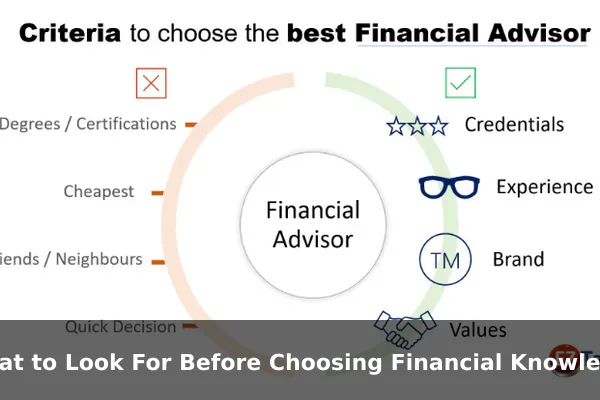
Every meaningful money decision you make — opening a savings account, paying down debt, buying insurance, or investing for retirement — rests on the financial knowledge you trusted beforehand. Yet most people spend far more energy choosing the decision than they spend choosing the source of the information behind it. That order is backwards. When the underlying guidance is biased, outdated, or simply wrong, even a careful decision can quietly lead you off course.
Financial information sits squarely in what search and trust frameworks call the “Your Money or Your Life” (YMYL) category, because acting on it can directly affect your financial security and wellbeing. That raises the stakes considerably. Not all financial content is created equal: a regulator’s plain-language explainer and an anonymous social media thread may both sound confident, but only one is accountable for accuracy.
This guide is not another list of money tips. Instead, it gives you a practical framework for evaluating financial knowledge before you rely on it — concrete signals of credibility, bias, accuracy, and relevance that you can apply to any book, website, course, video, or advisor. Learning to judge the source is itself a core financial literacy skill, and arguably the one that protects you most.
Why Vetting Financial Knowledge Is a High-Stakes Decision
Financial literacy is often described as knowing facts — what an index fund is, how compound interest works, what an APR means. Those facts matter, but they are only half the skill. The other half is judgment: the ability to assess whether a given piece of information is trustworthy, complete, and applicable to you. Without that judgment, more information can actually increase risk, because confident-sounding but flawed guidance crowds out careful thinking.
The consequences of poor sourcing are rarely visible right away. A misunderstood tax rule might not surface until filing season. An oversold “guaranteed” return might look fine until a downturn. Advice that ignores your debt situation might feel empowering until the interest compounds. By the time the error becomes obvious, money and time have usually already been lost.
The Difference Between Information and Reliable Knowledge
Information is abundant and cheap; reliable knowledge is comparatively rare. The distinction comes down to a few qualities:
- Accountability: Is anyone responsible if the information is wrong?
- Evidence: Are claims supported by data, regulation, or primary sources?
- Context: Does the source acknowledge when guidance depends on your circumstances?
- Stability: Is it likely to still be true next year, or is it a fleeting trend?
When you treat financial content as something to be vetted rather than simply consumed, you shift from a passive reader to an active evaluator — and that shift is where real protection begins.
Check the Source’s Authority and Credentials
The first question to ask of any financial resource is simple: who is behind this, and why should I trust them? Authority is not about a polished website or a large following. It is about demonstrable expertise, oversight, and accountability.
Prioritize Regulator-Backed and Institutional Sources
Some of the most reliable financial education is produced by public bodies whose explicit mandate is to inform and protect consumers and investors. These organizations have no product to sell you and are subject to public accountability. Strong examples include:
- The Consumer Financial Protection Bureau (CFPB), which publishes neutral guidance on borrowing, saving, and everyday money decisions.
- The U.S. Securities and Exchange Commission’s Investor.gov, which covers investing basics and fraud avoidance.
- The Financial Industry Regulatory Authority (FINRA), which offers investor education on brokerage and financial products.
- International bodies such as the OECD and the World Bank, which research financial literacy and inclusion at a global scale.
These are useful not only as direct sources but as benchmarks. When a less formal source makes a claim, you can compare it against what a regulator says on the same topic.
Evaluating Individual Authors and Advisors
Not every trustworthy voice is a government agency. Independent writers, educators, and advisors can be excellent — but you should look for verifiable signals before relying on them:
- Relevant credentials or licensing, such as a registered investment adviser or a certified financial planner designation, where applicable in your region.
- A clear, named identity rather than anonymity, so the person is accountable for what they publish.
- A track record of consistent, accurate work rather than viral one-off claims.
- Willingness to say “it depends” and to point readers to primary sources.
Be cautious with content where the loudest signal is confidence rather than competence. Authority that cannot be checked is not authority at all.
Look for Transparency About Bias and Conflicts of Interest
Even accurate information can be skewed by the incentives behind it. A great deal of financial content exists to sell something — a product, a course, a brokerage account, or a subscription. That does not automatically make it dishonest, but it does mean the guidance may be shaped to serve the publisher’s interests rather than yours.
Spotting Hidden Incentives
Train yourself to notice the business model behind the advice. Common arrangements to watch for include:
- Affiliate links, where the source earns a commission if you sign up for a recommended product.
- Sponsored content that promotes a specific company in exchange for payment.
- Product pushing, where a single solution is framed as right for everyone.
- Lead generation, where free advice exists mainly to funnel you toward a paid service.
None of these are inherently disqualifying. The key signal is transparency. Trustworthy sources disclose their relationships clearly — you should not have to guess how they make money. When disclosures are buried, vague, or absent, treat the recommendations with extra skepticism.
Independent Education vs. Sales-Driven Advice
A practical habit is to separate the educational portion of a resource from its commercial portion. A bank’s explainer on how mortgages work can be genuinely helpful even if the same bank ultimately wants to sell you a mortgage. The problem arises when education and sales are blended so tightly that you cannot tell where neutral facts end and persuasion begins. Independent, non-commercial sources are valuable precisely because they remove that ambiguity.
Verify Accuracy, Citations, and How Current the Information Is
Financial rules are not static. Tax thresholds, contribution limits, interest rates, regulations, and product features all change — sometimes annually, sometimes more often. A resource that was accurate three years ago may now be quietly out of date, and outdated guidance can be just as harmful as incorrect guidance.
Trace Claims Back to Primary Sources
Strong financial content does not ask you to take its word for it. It links or refers to primary sources — the regulator, the tax authority, the official rule, or the original research. When you encounter a specific factual claim about a rule, rate, or limit, ask whether you could verify it independently. If the source makes verification easy, that is a good sign. If claims float free of any reference, treat them as starting points for your own checking rather than conclusions.
Check for Dates and Update Notes
Before trusting time-sensitive details, look for:
- A clear publication or last-updated date.
- Any note about which tax year, rule version, or rate the content reflects.
- Language that acknowledges change — phrases like “as of” or “current limits may differ”.
Because prices, rates, rules, and availability can shift, it is wise to treat any specific figure as approximate until you confirm it against an official, current source. A responsible resource will encourage exactly that kind of verification rather than presenting numbers as permanent facts.
Assess Relevance to Your Situation and Region
Accuracy alone is not enough. Information can be entirely correct and still be wrong for you. Financial systems vary widely by country, and personal circumstances vary even more. Guidance that fits one reader’s situation may be irrelevant or even harmful for another’s.
Match Advice to Your Jurisdiction
Tax rules, retirement account types, consumer protections, and investment regulations differ from country to country — and sometimes within regions of the same country. Advice written for one jurisdiction may reference accounts, deductions, or protections that simply do not exist where you live. Before applying any rule-based guidance, confirm that it reflects your own legal and regulatory environment. International research bodies are useful for understanding broad principles, but the specifics should come from sources relevant to your location.
Match Advice to Your Life Stage and Goals
Beyond geography, consider how well the guidance fits your personal context:
- Income and cash flow: Strategies that assume surplus income may not work if you are managing a tight budget.
- Debt situation: Advice to invest aggressively may be premature if you carry high-interest debt.
- Life stage: Priorities for someone early in their career differ from those nearing retirement.
- Goals and risk tolerance: The “right” approach depends on what you are trying to achieve and how much volatility you can accept.
A trustworthy resource acknowledges this and frames its guidance conditionally. Be wary of any source that applies a single answer to everyone regardless of their circumstances.
Evaluate Depth, Clarity, and Balance
Good financial knowledge respects complexity without hiding behind it. It explains tradeoffs and risks rather than promising outcomes, and it makes ideas understandable without flattening them into something misleading.
Red Flags of Oversimplification and Hype
Certain patterns reliably signal weak or manipulative content. Watch closely for:
- “Get rich quick” framing or promises of guaranteed, effortless returns.
- Urgency and scarcity tactics designed to rush you past careful thinking.
- One-size-fits-all claims that ignore individual circumstances.
- Dismissal of risk, where downsides are minimized or omitted entirely.
- Jargon used to impress rather than to clarify.
In legitimate finance, higher potential returns generally come with higher risk, and almost every choice involves a tradeoff. Any source that denies this fundamental relationship is selling certainty that does not exist.
Signs of Balanced, High-Quality Explanation
By contrast, strong financial content tends to share several traits:
- It presents both benefits and drawbacks of a strategy.
- It distinguishes between general principles and individual decisions.
- It uses plain language while still acknowledging nuance.
- It encourages you to think, verify, and sometimes seek professional advice rather than simply obey.
Depth and humility usually travel together. The most reliable sources are comfortable saying that an answer depends on your situation — because in finance, it almost always does.
A Practical Checklist Before You Trust a Financial Resource
You can consolidate everything above into a quick mental scan. Before relying on any financial book, website, course, video, or advisor, run through this checklist:
- Authority: Who created this, and what makes them qualified or accountable? Can I verify their identity and credentials?
- Incentives: How does this source make money? Are conflicts of interest disclosed clearly?
- Evidence: Are claims backed by primary or official sources I could check myself?
- Currency: Is the information dated, and does it reflect current rules, rates, and limits?
- Relevance: Does it apply to my country, life stage, income, debt, and goals?
- Balance: Does it explain risks and tradeoffs, or does it promise guaranteed results?
- Clarity: Is it understandable without being misleadingly oversimplified?
- Tone: Does it encourage independent thinking, or pressure me to act quickly?
If a resource fails several of these checks, that does not mean every fact in it is false — but it does mean you should verify before acting. The more money or risk involved in a decision, the more of these boxes the source should clearly tick.
Where to Find Trustworthy Financial Education
Knowing what to avoid is only useful if you also know where to turn. Fortunately, some of the highest-quality financial education available is free, neutral, and produced specifically to serve the public rather than to sell a product.
Start With Regulators and Public Institutions
For foundational, unbiased education, public and regulatory bodies are excellent starting points and reliable benchmarks. Depending on your needs, consider:
- Consumer Financial Protection Bureau for everyday borrowing, saving, and consumer-finance topics.
- SEC’s Investor.gov for investing fundamentals and fraud awareness.
- FINRA for understanding brokerage and financial products.
- OECD and the World Bank for broader research on financial literacy and inclusion.
Because these organizations are accountable and non-commercial, they make ideal reference points. When you encounter a claim elsewhere, comparing it against one of these sources is a fast way to gauge its reliability.
Use Multiple Sources and Confirm Before Acting
No single source — not even an excellent one — should be your only input on a significant decision. Cross-checking guidance across two or three independent, credible sources helps you spot disagreements, outdated details, and hidden bias. For decisions with real financial weight, especially those involving taxes, large investments, or complex products, consider consulting a qualified professional who can account for your specific circumstances.
Conclusion
Choosing financial knowledge wisely is not about finding one perfect guru or website. It is about developing a repeatable habit of evaluation: checking who is speaking, why they are speaking, whether their claims hold up, how current they are, and whether the guidance actually fits your life. That habit turns you from a passive consumer of financial content into a discerning judge of it — a far safer position to occupy.
The signals in this guide — authority, transparency, accuracy, relevance, and balance — work together as a kind of quality filter. Used consistently, they help you lean on the resources that deserve your trust and quietly set aside the ones that do not. Because financial information shapes outcomes that can follow you for years, the few minutes it takes to vet a source are among the highest-return minutes you can spend. Start with neutral, accountable institutions as your foundation, verify before you act, and let good judgment about sources become the cornerstone of your financial literacy.
Official references
- Consumer Financial Protection Bureau – U.S. federal regulator providing authoritative, unbiased consumer guidance on borrowing, saving, and financial decision-making — a core YMYL trust signal.
- U.S. Securities and Exchange Commission – Investor.gov – Official SEC investor education resource covering investing basics, fraud avoidance, and financial literacy fundamentals.
- Financial Industry Regulatory Authority (FINRA) – Official self-regulatory authority for U.S. brokerage; its investor education materials anchor credibility on financial products and literacy.
- OECD International Network on Financial Education – International body setting global standards and research on financial literacy and education policy.
- World Bank – Financial Inclusion – Primary source for global data and research on financial access, literacy, and inclusion.
